
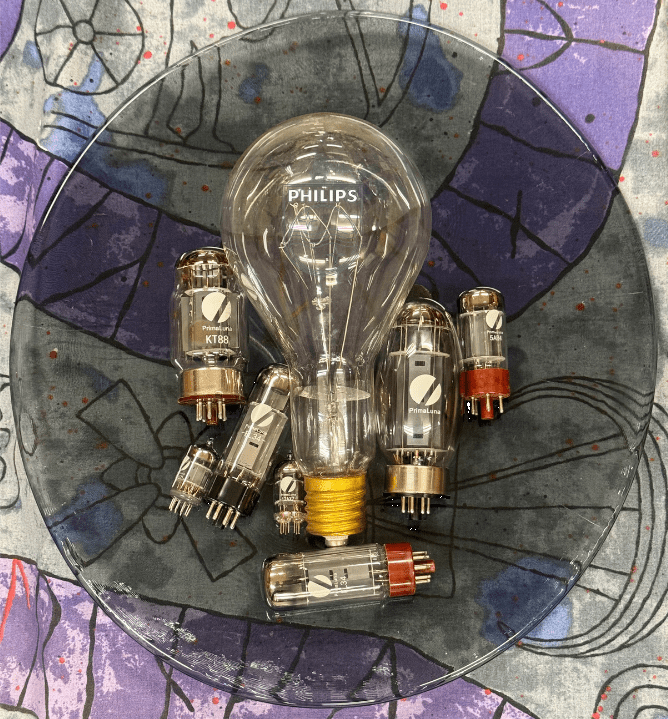
Turn on that fruit bowl!
While clearing out a corner of the warehouse, I found an irregularly shaped piece of glass that we used as a fruit bowl in the distant past. A gift from an old friend, colleague, and partner, Alfred de Theye. It is a strangely shaped object: heavy, asymmetrical, with a thick rim and a bottom that is not entirely flat. Not the kind of bowl you find at Blokker, but rather an abstract work of art made of glass.
Alfred said, “That’s not a fruit bowl. It’s –almost- a Cathode Ray Tube that never saw a picture.”
The bowl turned out to be a semi-finished product from the Philips glass factory in Eindhoven. Alfred did an internship there after graduating. Philips was a global player in television production.
This piece of glass was once intended to become the front screen of a cathode ray tube (CRT) — the heart of a television. It was formed by lowering molten glass into a metal mold. It would then be fused with the funnel part that contained the electron gun. The glass had to be perfectly pure to allow sharp black-and-white and later color images to pass through.
Not every piece passed the final inspection. Cracks, air bubbles, or a rim that was too thin meant rejection. Employees were sometimes allowed to take such “failed” semi-finished products home with them. That’s how the “fruit bowl” ended up at Alfred’s and later on my table.
The heyday of Dutch television
In the 1950s and 1960s, television came to life in Dutch living rooms. Philips produced millions of CRTs in Eindhoven. It was skilled work: glassblowers, metallizers, and other technicians worked side by side.
The CRT was a revolutionary technology. Behind the thick glass, electron beams danced, controlled by coils and high voltage, to build up an image point by point. The glass not only had optical functions, but also had to be able to withstand the vacuum inside and the implosion force of the air pressure outside.
Knowing this, you look at that thick, curved fruit bowl in a whole new light.
Tube light instead of electron beams
When I placed the piece of glass on my workbench, I immediately thought: “This is the perfect stage for a picture with a bunch of audio tubes.”
Where it was once intended to transmit the cool green-blue light of an electron beam, it now kind of captures the warm glow of PrimaLuna tubes.
It’s a beautiful contrast: the bowl tells the story of the first generation of imaging technology, while the tubes inside still symbolize traditional, analog audio.
From heritage to inspiration
For me, this piece of Philips glass is more than just a fruit bowl. It is a tangible reminder of a time when the Netherlands was a major player in the world of electronics — and of how technology once literally began with glass, fire, and craftsmanship.
When I see the bowl on my desk now, filled with audio tubes, I think of all the engineers, glassblowers, and technicians who worked on it. On the bowl, and on the tubes. It is a small monument to the manufacturing industry that laid the foundation for everything we do today.
In conclusion
Sometimes objects tell stories that are bigger than their form. A curved piece of glass can remind us of a time of pioneering, of high tension and high expectations.
And thanks to a good friend, that bowl is now a story. This piece of glass never made it so far that it was showing stories on television, but still, it IS a story. While the audio tubes on it still can tell you the Story of Music!


 PrimaLuna's Blog
Mooie beschouwing in deze donkere dagen over licht
Great account of your appreciation of history!